


Section 179 Tax Benefits for Small Businesses
If you own a small business, you should know about the Section 179 tax deduction for 2026 because it could save you money and help expand your business. The government created this deduction to encourage small business owners to invest in their businesses, but what can it do for you?
It can help you purchase the equipment you need now, making it so you don’t have to wait to save more money before buying what you need. Read on to learn how the Section 179 tax deduction in 2026 can help you, who qualifies for it, and what vehicles you can buy at Butler Ford.
Section 179 at a Glance for 2026
2026 Deduction Limit: $2,560,000
For the 2026 tax year, eligible businesses may deduct up to $2,560,000 in qualifying equipment purchases, including eligible new and used business vehicles. To qualify for the 2026 tax year, equipment generally must be placed into service by December 31, 2026, for calendar-year taxpayers.
2026 Equipment Spending Limit: $4,090,000
The Section 179 deduction begins to decrease dollar-for-dollar when qualifying equipment purchases exceed $4,090,000. The deduction is fully phased out when qualifying purchases reach $6,650,000.
2026 Bonus Depreciation: 100%
Under current federal tax law, qualifying business equipment acquired and placed into service after January 19, 2025, may be eligible for 100% bonus depreciation. This can allow businesses to deduct the full eligible cost of certain equipment in the first year, subject to applicable rules and restrictions.
The above is an overall, “bird’s-eye” view of the Section 179 Deduction for 2026.
Contact us for more details on limits and qualifying equipment.
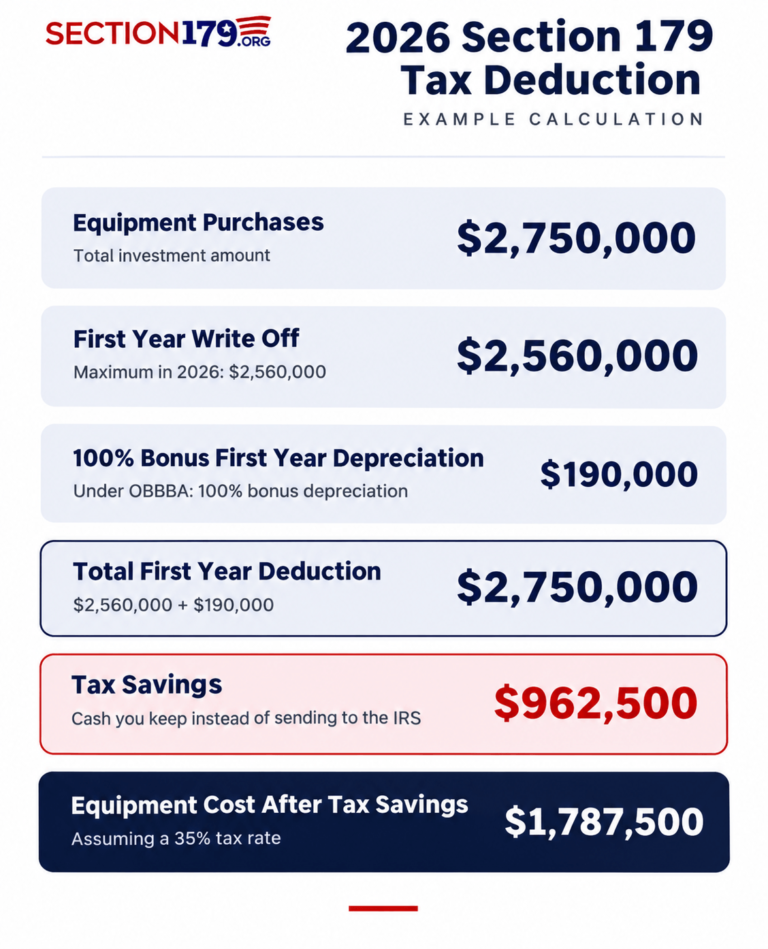
Here is an updated example of Section 179 at work during the 2026 tax year.
What is the Section 179 Deduction?
The Section 179 tax deduction gives your business a leg up, as you may be able to deduct the cost of qualifying equipment in the first year from your taxable income. This means you could invest in the vehicles your company needs and potentially save money when filing your taxes.
However, there are limits to the Section 179 deduction in 2026. For one, it has a $2,560,000 cap on the total amount you can deduct for 2026, and the deduction begins to decrease when qualifying equipment purchases exceed $4,090,000. Once purchases reach $6,650,000, the Section 179 deduction is fully phased out, as it focuses on helping small businesses grow.
Here’s an example of the Section 179 Tax Deduction in action:
- Equipment purchases: $2,750,000
- First-year write-off: $2,560,000
- 100% bonus first-year depreciation: $190,000
- Total first-year deduction: $2,750,000
- Estimated tax savings (35%): $962,500
- Equipment cost after-tax: $1,787,500
Who Qualifies for This Deduction?
If your business purchases qualifying equipment during 2026, you may be eligible for the Section 179 deduction. Both new and used vehicle purchases may qualify, along with certain types of business software and equipment.
Whether you purchase or finance your equipment, you may be eligible for Section 179 deductions. However, not every vehicle qualifies for the same deduction amount in 2026. Vehicles generally must be placed into service during the applicable tax year and used more than 50% of the time for business purposes.
What Models Are Included in the Tax Write-Off Vehicle List?
Use your Section 179 tax deduction here at Butler Ford when you explore our inventory of commercial vehicles. We have the vans, trucks, and SUVs in stock that you need to take your business to the next level.
Here are the types of vehicles that qualify for this deduction:
- Delivery cargo vans and box trucks without passenger seating
- Work vehicles with no obvious potential for personal use
- Specialty vehicles such as an ambulance or hearse
- Certain vans, pickup trucks, and SUVs with a GVWR over 6,000 pounds may qualify for Section 179 deductions and bonus depreciation, subject to vehicle-specific restrictions.
Some Ford models that may qualify for Section 179 deductions in 2026 include:
Who Qualifies for Section 179?
Businesses that purchase or finance qualifying new or used business equipment during the 2026 tax year may qualify for the Section 179 deduction, subject to applicable eligibility requirements and limitations.
Most qualifying tangible business equipment, including certain “off-the-shelf” software and business-use vehicles, may be eligible for the Section 179 deduction, subject to applicable restrictions.
For basic guidelines on what property is covered under the Section 179 tax code, please refer to the list of Section 179 Qualifying Equipment. Also, to qualify for the 2026 Section 179 deduction, equipment and/or software generally must be placed into service between January 1, 2026, and December 31, 2026, for calendar-year taxpayers.
For 2026, up to $2,560,000 of qualifying assets may be expensed under Section 179; that amount begins to phase out dollar-for-dollar when qualifying equipment purchases exceed $4,090,000.
Use Your Section 179 Tax Deduction at Butler Ford
Are you ready to expand your business by buying a qualifying Ford vehicle in 2026? Our team at Butler Ford can help you explore which models may qualify for Section 179 deductions and find a vehicle that fits your business needs.
Making a purchase as big as this one can be daunting, but it doesn’t have to be when you utilize the expertise of our staff. Visit us today at Butler Ford and discover the Ford truck, van, or SUV that may qualify for Section 179 deductions in 2026 and help your business grow.
Frequently Asked Questions
What's the difference between Section 179 and bonus depreciation?
Section 179 and bonus depreciation both allow eligible businesses to deduct the cost of qualifying equipment, but they have different rules and limitations. Section 179 has an annual deduction limit and is generally limited by business taxable income.
Both may apply to new and qualifying used equipment. Under current federal tax law, 100% bonus depreciation is available for certain qualifying property, subject to applicable requirements.
How do you calculate the cost of your equipment after-tax?
To calculate the estimated cost of your equipment after tax savings, first determine your eligible first-year deductions, including Section 179, bonus depreciation, and any applicable regular depreciation.
Multiply your eligible deductions by your applicable tax rate to estimate potential tax savings. Then subtract those estimated savings from the original equipment purchase price to calculate your estimated after-tax cost. Actual savings depend on your business’s tax situation and applicable tax laws.
Please visit www.Section179.Org for more information.


